
Integrate the RentCast API with AI tools, assistants and agents.
We provide several tools and utilities to help you connect our API, documentation and property data to different AI tools, code editors, assistants and agents.
These tools can help you and your AI agents quickly find answers in our documentation, generate integration code, make requests to our API endpoints, and better understand our API platform.
AI Tools Menu
Each of our API guides and endpoint reference pages includes an AI tools menu at the top of the page:
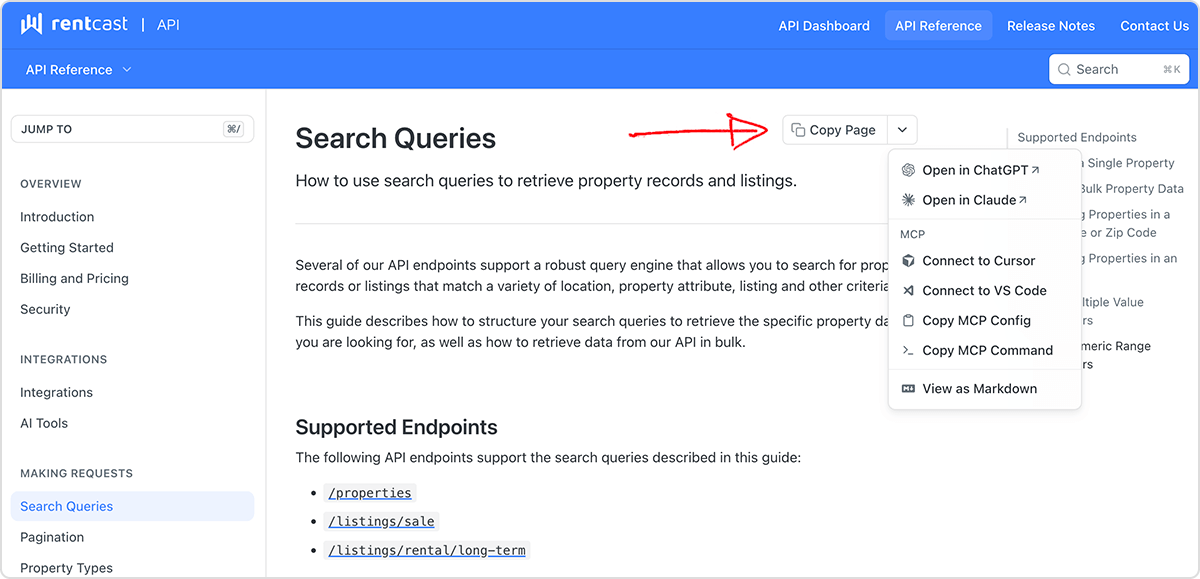
This menu includes several links to help you share our API docs with AI assistants, connect to our MCP server, and view or copy an AI-friendly version of the current documentation page:
- AI assistant links: send the current page to an AI assistant, such as ChatGPT or Claude, so you can ask it questions about our API
- MCP connection links: connect our MCP server to AI-enabled code editors, or copy our MCP configuration and commands for use in compatible tools
- Markdown links: view or copy the current page in structured Markdown format, which is useful for sharing it with other AI tools, agents or Markdown-compatible readers
LLMs.txt File
LLMs.txt FileAn LLMs.txt file is an AI-readable Markdown index that lists all of our documentation pages and helps AI assistants and agents understand the structure of our API docs.
This file is often a better entry point for AI assistants, agents and other tools to understand and interpret our API platform and endpoints, and can help those tools provide more accurate information and answers.
Our LLMs.txt file is published at https://developers.rentcast.io/llms.txt, and you can send this link directly to your AI tools that need to understand and work with our API platform.
MCP Server
The RentCast API Model Context Protocol (MCP) server gives compatible AI tools a live connection to our API documentation and endpoint definitions.
Once connected, AI code editors, IDEs, assistants and agents can search our documentation, inspect available API endpoints, generate integration code and, when configured with a valid API key, make API requests on your behalf.
MCP Server Features
The Model Context Protocol (MCP) is an open standard that allows AI to securely access external data sources and tools, such as REST APIs. The RentCast MCP server provides AI tools with:
- Documentation search and retrieval
- Endpoint discovery and schema inspection
- Code generation assistance for API integrations
- API request execution when configured with a valid RentCast API key
- Access to live property data through our API endpoints
You can use our MCP server with AI tools and code editors such as Cursor, VS Code, Claude and JetBrains, as well as other AI development tools, assistants and IDEs.
Setting Up MCP Connections
The RentCast API MCP server is hosted at https://developers.rentcast.io/mcp.
To set up a connection between your AI tools and our MCP server, you typically just need to provide the MCP server URL above, which is accessible to the public.
If you'd like to enable your AI tools to make requests directly to our API endpoints on your behalf, you will also need to provide them with your API key, which should be sent in the X-Api-Key request header. You can view your API keys on your API dashboard.
The examples below show how to connect our MCP server to several popular AI tools and code editors. Replace YOUR_API_KEY with your actual RentCast API key if you want your AI tool to make live requests to our API endpoints:
Add the following configuration to your Cursor MCP config file, either at .cursor/mcp.json in your project or ~/.cursor/mcp.json for all projects:
{
  "mcpServers": {
    "rentcast": {
      "url": "https://developers.rentcast.io/mcp",
      "headers": {
        "X-Api-Key": "YOUR_API_KEY"
      }
    }
  }
}
Open the Command Palette and run MCP: Add Server, or add the following configuration to your VS Code MCP config file, either at .vscode/mcp.json in your workspace or in your user MCP settings:
{
  "servers": {
    "rentcast": {
      "type": "http",
      "url": "https://developers.rentcast.io/mcp",
      "headers": {
        "X-Api-Key": "YOUR_API_KEY"
      }
    }
  }
}
Add our MCP server as a custom connector in Claude using the following MCP server URL:
https://developers.rentcast.io/mcpTo enable live API requests, provide your RentCast API key using the X-Api-Key header in the connector settings, or when Claude prompts you for it directly in the chat.
Run the following command in your terminal:
claude mcp add --transport http rentcast https://developers.rentcast.io/mcp \
  --header "X-Api-Key: YOUR_API_KEY"
Add the following configuration to your JetBrains AI Assistant MCP settings:
{
  "mcpServers": {
    "rentcast": {
      "url": "https://developers.rentcast.io/mcp",
      "headers": {
        "X-Api-Key": "YOUR_API_KEY"
      }
    }
  }
}We recommend avoiding committing your RentCast API keys to source control. Store API keys in a user-level config file, environment variable or your AI tool's credential manager when possible.
An active RentCast API subscription and an API key are required to enable AI agents to make requests to our API endpoints. If you haven't set these up yet, follow this guide to do that first.
Testing MCP Connections
Once you've configured the MCP connection, your AI tool should have access to our API documentation and endpoint definitions.
To test that everything is working correctly, start a new chat with your AI assistant and ask questions like:
- What can you tell me about the RentCast API?
- Which endpoint should I use to look up property records by address?
- What query parameters are supported by the property listings endpoints?
- Show me an example request for retrieving rental listings in a specific city
- Create an integration with [another platform] using the RentCast API
If you configured the connection with a valid RentCast API key, you can also ask your AI assistant to make a test request to one of our API endpoints and show you the response.
All successful API requests made through our MCP server will be counted for billing purposes. We strongly recommend setting usage limits or request caps directly in your AI agent, application code or integration to prevent excessive usage and unexpected overage fees.